



PROJECT NAME: Baseline Assessment of Business Continuity and Disaster Response Planning for Caribbean Utilities
SELECTION PROCESS : RG-T4623-P002
SELECTION METHOD: Simplified Competitive
COUNTRY: Regional
SECTOR OR DEPARTMENT: Energy
TC NAME: Resiliency of Power Infrastructure and Response Preparedness for Energy Service Restoration
FUNDING – TC : ATN/SR-21488-RG, ATN/OC-21383-RG and ATN/OC-21384-RG
LINK TO TC DOCUMENT: https://www.iadb.org/document.cfm?id=EZIDB0002758- 917381471-30
The Inter-American Development Bank (the Bank) was established in December of 1959 to help accelerate economic and social development in Latin America and the Caribbean. Today, the Bank is a major catalyst in mobilizing resources for the region (For more information about the Bank, please refer to the Bank’s website at www.iadb.org.)

1.1 The Bank is executing the above-mentioned The Bank intends to contract consulting services described in this Request for Expressions of Interest (REOI). The purpose of this REOI is to obtain sufficient information to enable the Bank to evaluate if the eligible consulting firms (CF) have the experience and qualifications relevant to provide the consulting services requested by the Bank.
1.2 As defined in the Corporate Procurement Policy (GN-2303-33), participating CF must be from a Bank’s Member Country1 or Territory2 to be eligible to submit an Expression of Interest (EOI). . CF with the required experience relevant to the assignment shall be assessed. The Bank will conduct the assessment and ranking of the EOI submitted by the CF that expressed interest. The Bank will invite CF to submit a proposal in the order in which the ranking is established. If the proposal of the first-ranked CF is acceptable, the CF will be invited to negotiate a Contract. If the negotiations with the first-ranked CF fail, the next-ranked CF may be invited to submit a proposal and negotiate.
1.3 This REOI is not to be construed as either an RFP or an offer to contract and in no way obligates the Bank to contract anyone. The Bank reserves the right to reject any and all participating CF for any or no reason without having to provide an The Bank does not bind itself in any way to select any participating consulting firm. No debrief will be provided as to why CF have or have not been shortlisted.

2.1 Expressions of interest must be delivered using the Bidder Portal for the Selection and Contracting of Consulting Firms for Bank-Executed Operations (the Portal) (http://beo-procurement.iadb.org) by: October 31st, 2025, 5:00 M. (Washington, D.C., Time) in PDF format only (Max. 45MB).
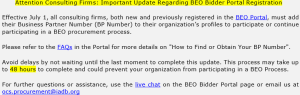
2.2 To access the Portal, the CF must generate a registration account, including all the data requested by the Portal. If any of the information requested is not included, the consulting firm will not be able to participate in this or any other Bank-executed selection process for operational work. If the consulting firm has been previously registered, please validate that you have all the consulting firm’s information updated and complete before submitting an EOI.
2.3 Eligible CF may partner in the form of a Consortium/joint venture (JV) to enhance their qualifications. Such Consortium/JV shall appoint one of the CF as the representative responsible for the communications, the registration in the Portal, and the submission of the corresponding documents.
2.4 Interested CF may obtain further information during office hours, 09:00 AM to 05:00 PM (Washington, D.C. Time), by sending an email to: Roberto Aiello (raiello@iadb.org)
Inter-American Development Bank
Division: Energy
Attn: Roberto Aiello, Program Team Leader 1300 New York Ave, NW
Washington DC, 20577
Tel: 1-202-623-2066
E-mail: raiello@iadb.org Web site: www.iadb.org
2.5 The Bank hereby invites eligible CF to indicate their interest in providing the services described below in the draft Terms of Reference for the consulting services. Interested CF must provide information establishing that they have the necessary experience and are qualified to perform the services. So that all responses may be properly evaluated, eligible CF must include in their submissions the information requested in the following section, with full and clear.

3.1 The consulting services include conducting a baseline assessment of disaster preparedness and continuity planning efforts among CARILEC’s member utilities in ONE Caribbean countries (Barbados, Belize, Guyana, Jamaica, Suriname, The Bahamas, and Trinidad and Tobago), reviewing existing business continuity and disaster recovery plans, evaluating institutional and technical emergency preparedness capacities, identifying gaps and development needs, and delivering a detailed assessment report with a proposed work plan and budget to enhance operational Consulting services should be completed within four (4) months. The estimated budget for this consultancy is US$100,000.
3.2 Although there is no standard format for presenting an Expression of Interest, eligible CF must submit an EOI containing the following information:
-
- Basic Information—Provide the official name of CF, the contact’s name, email address, phone numbers, and office address (es) of the key contact (s) responsible for the EOI.
- Background—Provide a description of the CF. The CF may include brochures or documents that provide information about its organization, history, mission, structure, and number of staff.
- Experience related to the requested consulting services—Provide all kinds of evidence the CF considers appropriate to show its experience and expertise in delivering services similar to those described in Annex A, Terms of Reference (e.g., brochures, reports, studies, description of similar assignments, references to cases in which it has provided similar services, experience in similar conditions, availability of appropriate skills among staff, etc.
3.3 Estimated budget: US$100,000

Please note that the attached Terms of Reference may be subject to changes by the Bank. The CF that have been shortlisted will be notified of these changes.
ANNEX A – Terms of reference
1. JUSTIFICATION AND BACKGROUND
1.1 Power utilities across the Caribbean regularly face the disruptive impacts of natural disasters and severe weather events, which significantly impair electricity infrastructure and operations. For example, in 2024, the Atlantic Basin recorded 18 named storms, five of which developed into major hurricanes, causing extensive damage in several jurisdictions. These disruptions place considerable strain on national economies, particularly in small and resource-constrained states where fiscal space is already limited.
1.2 Energy sector assets are increasingly exposed to operating conditions beyond their design specifications, increasing the risk of structural damage, collapse, malfunctioning, and reduced performance. This has consequential impacts on other sectors including health, water supply, land transport and port Further, under post-disaster conditions, the disruption of critical sectors may translate into severe losses in terms of ecosystems, infrastructure assets, and economic output.
1.3 Electric utilities must be prepared to respond efficiently and restore services swiftly following disasters to reduce recovery time and minimize However, many face internal challenges that constrain their response capabilities. These include inconsistent or ad hoc approaches to disaster risk management (DRM) and weak coordination with national and regional response frameworks. 3 In numerous cases, utilities operate without formal Business Continuity Plans (BCPs) and Disaster Response Plans (DRPs) or rely on strategies that do not reflect current operational conditions or hazard exposure.
1.4 Strengthening the resilience of regional utilities calls for a comprehensive and strategic approach that begins with understanding their current state of preparedness. This involves conducting a thorough baseline assessment of existing BCPs and DRPs, where they exist, to determine their adequacy, relevance, and level of integration into utility
1.5 At the same time, it is essential to identify and address gaps in technical capacity within utilities. Many personnel lack sufficient expertise in key areas such as risk assessment, emergency planning, and crisis management, which significantly limits their ability to develop, implement, and maintain effective continuity and disaster response Strengthening these capabilities is vital to ensuring that utilities are not only prepared for disruptions but are also able to recover quickly and sustain essential services under challenging conditions.
1.6 To support this effort, the Bank, in collaboration with the Caribbean Electric Utility Services Corporation (CARILEC), is providing technical assistance to CARILEC’s member utilities in ONE Caribbean countries, i.e., The Bahamas, Barbados, Belize, Guyana, Jamaica, Suriname, and Trinidad and Tobago. This support focuses on assessing the current status of business continuity and disaster response planning, while also identifying training and capacity development needs.
2. OBJECTIVES
2.1 The objective of this assignment is to support CARILEC’s member utilities in ONE Caribbean countries by conducting a baseline assessment of their disaster preparedness and continuity planning efforts, using a multi-hazard The findings will inform future actions to improve operational resilience and enhance the ability of utilities to prepare for, respond to, and recover from major disruptions.
3. SCOPE OF SERVICES
3.1 The Consulting Firm (hereafter “The Firm”) will conduct a review of existing BCPs and DRPs across participating utilities, assessing their adequacy and alignment with current risks. Where no plans exist, the Firm will document this and assess the implications for operational
3.2 In parallel, the Firm will examine institutional and technical capacity related to emergency preparedness across all beneficiary utilities. This will include a review of existing plans, where available, as well as the identification of gaps in utilities that lack formal disaster recovery The assessment will draw on inputs from utility staff and key stakeholders to identify systemic challenges and development needs.
4. KEY ACTIVITIES
4.1 The Firm will undertake the following tasks for participating utilities:
4.11 Baseline Assessment BCPs, DRPs, and Operational Integration
Conduct a detailed review of available BCPs and DRPs of participating member
- Evaluate the adequacy, clarity, and structure of each plan in relation to utility operations, risk environment, and organizational
- Identify the types of hazards covered and determine whether the plans adopt a multi- hazard
- Use surveys or other diagnostic tools, as appropriate, to gather data on current practices, challenges, and institutional needs.
- Assess, through consultations with utility staff and stakeholders, how well existing plans are embedded in daily operations to identify opportunities for better alignment between documented plans and practice.
4.12 Gap Analysis of BCPs and DRPs
- Identify strengths, weaknesses, and limitations of current continuity and disaster response planning frameworks.
- Highlight where plans are outdated or incomplete, based on benchmarks such as CDAP requirements, national/regional DRM policies, and/or utility self-assessments, and evaluate the level of alignment with relevant DRM frameworks and response
- Document where no plans exist and assess the implications for the utility’s resilience and operational continuity.
4.13 Human Resources and Training Needs Assessment
- Evaluate the current technical capacity and staffing levels of utility personnel involved in emergency response and business continuity functions.
- Assess the availability of financial and other resources to support ongoing DRM and continuity planning activities.
- Identify gaps in knowledge, skills, tools, and institutional arrangements required not only for effective continuity and emergency planning, but also for strengthening overall utility resilience. This includes capacities related to risk anticipation, hazard identification and management, incident command systems, response, and
- Identify specific training needs and capacity-building opportunities required to address the gaps and strengthen each utility’s resilience and emergency preparedness capabilities.
4.14 Stakeholder Engagement
- Conduct interviews and/or focus group discussions with utility technical staff and management, and relevant external stakeholders to complement baseline
- Facilitate discussions and working sessions to validate findings and ensure that recommendations are co-created, context-specific, and informed by real-world operational experiences.
4.15 Reporting
-
- Prepare a comprehensive baseline assessment report that includes:
- A summary of the status of BCPs and DRPs across participating
- Identified gaps in technical and institutional
- Analysis of risks related to the absence or inadequacy of planning
- Practical, prioritized recommendations for strengthening preparedness and continuity
- Develop a proposed work plan and budget outlining recommended activities to address key gaps, enhance institutional resilience, and guide IDB future
- Prepare a comprehensive baseline assessment report that includes:
4.1.6 Coordination and Collaboration
- Work closely with CARILEC and relevant regional bodies to ensure alignment with regional DRM frameworks and utility sector priorities.
5. EXPECTED OUTPUTS AND DELIVERABLES
5.1 The Firm shall provide the following deliverables:
- Deliverable 1: Inception report, outlining the methodology, timeline, and stakeholder engagement
- Deliverable 2: Draft assessment report, including stakeholder consultation summary and training needs assessment.
- Deliverable 3: Final assessment report, workplan, and budget, taking into consideration feedback from key stakeholders.
6. PROJECT SCHEDULES AND MILESTONES
6.1 This assignment shall have a duration of 4 months following the proposed timeline:
| Deliverable | Delivery schedule |
| 1. Inception report | 2 weeks after contract signature |
| 2. Draft assessment report | 3 months after contract signature |
| 3. Final assessment report | 4 months after contract signature |
7. REPORTING REQUIREMENTS
7.1 The deliverables must be submitted to the IDB in English and in an electronic file.
7.2 For reports containing modifications based on respective observations, documents must be submitted with track changes to ensure proper traceability of how the observations were addressed.
8. ACCEPTANCE CRITERIA
8.1 Deliverables will be accepted based on agreements on the scope of services
8.2 Additionally, deliverables will be reviewed and approved by Mr. Roberto Aiello (raiello@iadb.org), in close coordination with
8.3 Partial deliverables, or deliverables that are not accepted, will not be paid.
9. CONSULTING FIRM AND TEAM REQUIREMENTS
9.1 The Firm should have at least five (5) years of experience in DRM, business continuity planning, emergency preparedness, and institutional capacity assessments, preferably within the energy sector.
9.2 Experience working with utilities, government agencies, and regional organizations in the Caribbean region is highly desirable.
9.3 The Firm will be expected to deploy a multidisciplinary team with expertise relevant to the scope of work.Language requirements: English (mandatory) and Dutch (desirable).
Further information can be found here: https://www.iadb.org/document.cfm?id=EZIDB0002758-1806295179-27